

Previous *** Table of Contents *** Next
The night wore its starless blackness like a shroud.
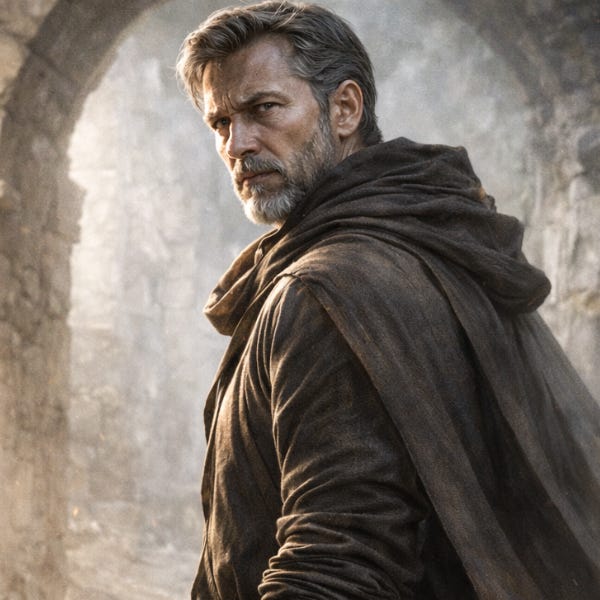
Triangle Garden smoldered behind him, a slow, smoking hiss of char and stone. Alric could name every component by smell; twenty-five years behind stone walls had taught him to listen with his nose when his eyes lied. The air told him two truths: two days of fire and explosions had burned five years of work to ash, and the man who made him bleed was gone.
His left leg was a forge. Every step was agony, every shift of weight sent sparks up his spine. Elias Ward had put the blade in with a surgeon’s contempt. Not a killing stroke. Worse. A correction. The kind of cut that reminded a man his body was only as good as his tools. Alric’s tool, his Valkyrie potion, had been good. But not good enough to stop the Reaper.
You spared me, Alric thought, teeth tight. You arrogant bastard. You think that’s mercy. It’s not. It’s a leash. And I will not be held…no, I will not be leashed.
He did not fall. He would not submit. The aliens had kept humanity on its knees for over two thousand years. He leaned once against a toppled wall where lichen made a river map down the stone. Mortar grit bit his palm. He forced his breath to even out. He would not kneel. Not ever.
Silence surrounded the grounds like a held breath. No crickets or frogs. It was as if the earth itself flinched from the idea that the Reaper had walked here again. Country superstitions said the land remembered men like Ward and waited to make a sound until they were gone. Alric had known better. He had used the myth all the same. No longer.
He dug inside his coat. Found the inner pocket, stitched high where even a thorough search would overlook it. His fingers closed on cold perfection. His last one. The effort to pull it out made him gasp.
It lay in his palm like a polished fang. No screw head nor brass seam where metal met metal. Just a smooth cylinder with faint etched lines that woke under his thumb. It was technology. The key to humanity’s survival. To freedom.
A soft hiss answered his touch. Pale green light breathed along the tool. A different century’s logic thrummed against his bones. Alric had learned not to call it magic. It was a burning coal. A reminder of how much had been stolen from them. Of the countless lives wasted to limit these miracles. They would rise again. He swore it.
He pushed the trouser leg up and found the wound by feel. The sword had taken a bite high and inside, just shy of the femur’s head. The tourniquet had kept him alive those first few hours as he crawled out of the facility, but he’d had to take that off when he used the first injector. Now, two days later, the injectors had created a debt his body would soon collect. The muscle’s torn edges were hot and slick; the joint felt wrong, as if a hinge had been twisted.
He knew the injectors he’d already used were all that had kept him from losing the leg, but he did not name the damage to himself. Names invited fear. He didn’t have time to fear just now.
He set the cylinder against his skin and pushed.
Cold came first, like snowmelt flooding cracked stone. Then heat like a river rushing through a culvert. Pain rose as that river crested. His vision narrowed to the point of the needles in his thigh. His throat wanted a sound; he refused it.
Then it stopped. His leg was numb. He felt the device hum against bone, and looked, despite himself. Tendons had drawn tight as if an unseen hand had found each one and hauled them together. Torn muscle now clenched to the shape of the leg. A cold stiffness settled in the joint. It was not healing. It was a brace. A scaffold hammered up in bad weather so the walls would not fall before the storm passed.
The light along the injector dimmed and died. The hum faded. He held it one heartbeat longer to feel the last of the injector’s thrum, then flicked it into the rubble. It clinked and vanished.
He tested the leg. While the wound was calm, pain had not vanished completely. Instead, it had now rearranged itself into a lattice he could use. The joint obeyed enough. The tendons’ wire-hardness made his teeth clench, but the weight stayed under him. It would last an hour or two. Three, if he lied to both it and himself in equal measure.
He set off again, limping, the limp made precise by his pride. A stag with a single arrow still runs. A man who outlived a prison cell won’t give a wall the satisfaction of catching him.
Alric’s mouth tightened. He could just see smoke ahead in the moonless night. He had taken the route he’d memorized before the fight: past the old pump-house, then over the ditch where water stood ankle-deep even in summer. That crossing had almost finished him. He’d waited for the middle of the night to avoid the tainted water. Finally he’d slipped along the razed hedgeline that hid the wagon ruts used to supply the laboratory.
He had built escape maps in his mind since he had first come here five years ago. He’d learned this habit in the prison he’d lived in for twenty-five years before the Traditionalists had helped him slip Vexin’s grasp. He would never be surprised again.
He crossed the ditch with a short hop that flashed white-hot. He used the breath it stole to empty his lungs of a thought: He didn’t finish me. Why didn’t he finish me?
From most men, they would call it luck. From Ward, survival was a calculation. He spared men only when the outcome was already written in his favor. Alric didn’t spare men. Mercy just led to more work later.
The road became weedy gravel, then packed dirt. A faint coal smell threaded the air. He followed it until the smoke thickened into a thin plume he could see. Rails lay ahead like a black vein sewn through the scrub. He had chosen this line because it was unused, and men in uniforms could be bribed to forget it existed. Alric liked forgotten places. If no one watched him, he could choose when to be seen.
He checked himself before approaching the grove: breath thin but not spent; leg a problem postponed. He steadied his hands and shifted his coat to hide the blood. Blood made men think of endings; he wanted beginnings.
Ward intruded into Alric’s thoughts. He relented and remembered his enemy once, not as title or myth, but as boy and man. A rangy, stubborn brat at sixteen, the pride of the Royal Academy, all quick hands and unwarranted courage. Then the soldier. His eyes like frozen steel, turning order into a weapon and calling that mercy. Thirty years had not blunted either picture. Tonight welded them.
You spared me, he told the smoke in Ward’s place. I’ll teach you the price of your mistake.
The scaffold held. His boot found the crosstie. The ground tilted with the memory of iron and speed. Lantern light trembled along willow trunks like fireflies nailed in place.
Men rose from the shadows as he approached. Their weapons showed first. Honest, unforgiving pikes; staves polished by hands that could afford nothing else; crossbow limbs cranked beyond any game hunt’s needs; knives ground and reground until they were all edge.
The faces came next: hungry and hard. A few carried the posture of men who had been soldiers once, but the uniforms were now gone, sold, traded, or burned a long time ago. Others wore Dunhaven greens turned into civilian coats, the buttons replaced and the seams let out. A couple wore the gray of the GSS, minus pride. One had a Granblue naval coat, too big in the shoulders, with salt stains like maps.
None of them spoke his name aloud. That was loyalty and superstition both. Names traveled. Names were power. The nearest man took half a step as if to offer an arm. Alric shouldered past without breaking stride. Weakness tonight would be read as permission to doubt in the morning.
He mounted the iron steps at the engine’s rear. Halfway, the leg tried to betray him. The brace the injector had built did its ugly job; the joint held; the tendon tightened like wire under his trousers. He made no sound. That cost him.
The platform boards thudded under his boots, and then he was inside the lead car. Heat pressed against his face; coal grit found his teeth.
The train wasn’t handsome. That wasn’t its job. The paint, what little of it remained, was a nondescript gray that had once pretended to be blue. The boiler’s jacket showed places where someone had replaced plates with scavenged metal riveted into a patchwork that caught lamplight in different moods. The cowcatcher was bent where it had bullied a boulder. The tender behind the engine slouched under a half-load of coal and a tarp that knew every trick of the wind. The cars had their windows boarded from the inside with uneven planks, then caulked with pitch that glistened black in the lantern glow.
The stove ticked as it warmed, iron answering heat in little sighs. Somebody had polished the top with sand until it had a dull mirror shine. The brazier in the corner threw a heart-red light that painted everything with fatigue. A low whistle valve complained somewhere underfoot. It was a long, thin note like a kettle too long on the fire. Alric’s eyes adjusted. As they did, two lieutenants stood to attention, awkwardly careful not to knock their knuckles against the table bolted to the floor.
“General,” the taller said, and then as if he’d put too much emphasis on the word and felt it: “Sir.”
Alric nodded to both, acknowledgment without welcome. He smelled them: sweat and leather oil cut with coal, the faint animal musk of men who had slept in their coats so they would not have to put them on when they woke up. He noted the small things because small things told the truth: the way the taller man’s thumb worried an old burn scar when he was trying not to look at Alric’s leg; the way the shorter man’s eyes tracked the door without moving his head, measuring the seconds it would take to get there if the car filled with knives; the way each paused a fraction before breathing, as if waiting for permission. That last told him more than a fitness report. They were ready to obey, but they were waiting to see which version of him had climbed the steps: a legend made flesh, or a man limping out of the rubble.
“Is the line clear?” Alric asked. Calm. Even. You didn’t use emphasis on questions that needed true answers.
“Yes, General,” the tall one said. “Scouts as far as Miller’s Cut. No patrols. No signals on the main. Switch looks rust-welded; we can break it if we have to, but better to take the spur north. Fewer eyes.”
“Better,” Alric said. He let the word be approval and order both. “Stoke her high. I want to be in the Confederation yesterday.”
The shorter man didn’t wait for a second instruction. He shouldered past to the firebox and hauled the door. Heat flared yellow-orange as it sucked the air from the car. He fed the beast with two quick shovels, then three slower ones, watching the bed until it settled into a more useful anger. The engine under the flooring deepened its note, the rumble moving from planning to promise. Somewhere behind the partition the tender creaked as coal shifted to meet the hunger. The car did what living machines do: it took a breath.
Alric lowered himself into the iron-backed chair beside the bolted table. The chair had been built for men shorter by six inches and wider by a foot; it bit his shoulder blades in the way of old furniture that thinks your bones should be the ones to make the first move. Fine. Pain could sit at the table if it behaved. He placed both hands on the wood until the tremor left them. He watched his own shadow on the car wall. Shadows were currency with men like his. You made them believe you were bigger than your limits, and then, suddenly, you were.
He pulled a wax-sealed packet from his coat and flattened it under his palm. He did not open it yet. Orders written too fast are their own kind of mistake; you let the system find its rhythm first so men can pretend the rhythm comes from you.
“You waited,” he said, eyes still on the packet.
“Yes, sir,” the tall lieutenant answered. “Two nights since the explosions. We didn’t know if…” He stopped. Alric noted that. The man had seen the abyss and stepped back from it. Smart.
“You waited,” Alric repeated. This time he let it be praise. “Good.” He looked up. “Names.”
“Lyle, sir,” the tall one said. “Lyle Ain.” He had the voice of a man who had learned to make orders sound like choices to get better results: soft around the teeth, hard on the vowels.
“Kerrel,” said the other. “Kerrel Dawn.” He kept his chin at a military angle he’d probably taught himself from a woodcut. He’d either snap cleanly or bend until something important in him never stood straight again. Alric had use for both kinds.
“Who’re your shadows outside?” Alric asked. He had counted four at the lanterns, two at the switch, one on top of the last car. Good position for that last one. A bad habit for a man if he liked skylines more than floors.
“Brant and Saye at the willows. Two more behind them. Hollen and Filips at the switch. Soot on the roof.”
“Soot?” Alric said.
Kerrel’s mouth moved as if around a grin he did not let live. “He doesn’t answer to his given. Looks like he crawled out of a chimney. Sort of… stuck.”
“Keep him,” Alric said. “Men who like roofs see things men on the ground miss.” He tilted his head toward the forward wall. “What’s ahead?”
Lyle took a breath like a man stepping into cold water. “We have the spur as far as Stallman’s Yard. Past that, the line runs toward the river. Two choices: take it and risk the bridge. The river watch might notice. Or ease north through the warehouses and pick up the outbelt to the Confederation. We have a friend at the north signal, but the Freeholds have been eating loyal men lately. If he still draws breath, we can ride the outbelt straight through and never touch the main track.”
“You trust him?”
“I trust his self-interest,” Lyle said, careful this time. “He’s a man who likes his children. He does the math before he takes a coin. Your last plan kept them fed.”
The last plan had never met the Reaper’s sword. Alric rubbed the edge of the packet with his thumb, feeling the ridges of the seal. Had trusted, trusts, will trust. Tense shifts were weathervanes. A man who liked his children could be made to do anything if he thought it kept his house intact. You didn’t fault him for it; you made it so his math couldn’t land anywhere else but you.
“How long to depart?” Alric asked.
Kerrel rested his face against the metal, listening with his jaw. An old coalman’s trick, reading the engine through the bone. “Ten for a good head. Fifteen if you want her singing.”
“Ten,” Alric said. “I don’t need music. I need motion.”
The silence that followed was not empty. It was filled with the right noises: iron ticking, fire growling, boots shifting just enough not to cramp, someone’s quiet cough that said he had been smoking cheap leaf to stay awake. Outside, along the platform, the low murmurs of men re-slinging gear and lying to their own legs about how long they could stand. Alric let it play out. Where he led, he didn’t always talk. He chose which sounds were allowed to mean we will live.
“Who else knows this line?” Alric asked, not turning his head.
Lyle answered. “Two boys in Stallman’s yard run the switch for us. There’s an old woman at the water tower who sells coffee. She knows when to look away. A coalman named Reddick who thinks he’s smarter than he is. He could put it together if he had a week and people stopped interrupting him. He’s never had either.”
“Good,” Alric said. Interruptible men were a kind of safety. “And the Sentinels?”
Kerrel, blunt: “They don’t think in rails, sir. Or much of anything unless horses are involved. Five minutes diversion by our two men in the yard, and we’ll be safely in the Freeholds. Sixteen hours after that and we’re in the Confederation.”
Alric let himself approve of that, because it was true. Dunhaven’s thinking ran along hedges and stables. They liked uniforms and doorways and execution yards. Alric knew better. Rails held a nation together better than crowns or flags. Men who forgot that usually ended in shallow graves that were eventually buried under the same rails.
Kerrel turned to give the word, then stopped and looked back. Questions hovered, sharp and unspoken, that none could ask clean and keep their necks. How bad? Are you still with us? Will this hold?
Alric spared them the indignity of saying it out loud. “We ride. We are not chased. We will not be stopped. If we are met, we do not stop. We are inevitable.” He let his gaze go from one to the other. “I am not finished. Neither are you.”
Alric let the words hang a moment, then lifted his chin. “What cannot be broken?”
Kerrel’s voice came first, rough with coal dust: “The will to be free!”
“Free men—”
The others picked it up, a murmur hardening into a rhythm.
“—have no masters.”
“A thousand thorns—”
“—bleed a giant dry.”
The reply came like a vow. Not shouted, but sharp, meant to travel further than lungs.
Kerrel’s shoulders came up as if strings were attached. Lyle’s mouth broadened into a smile of triumph.
Alric sat in the vestibule a moment longer and watched the willows move in the night breeze. He thought briefly of his people who had fallen at Triangle Garden. The weight of it pressed against him, but not for long. They had died for the greater good. The only good worth naming. The freedom of humanity from its chains.
He felt the sadness, yes, but sadness was not permission to falter. He would grieve when they were free, not before.
The whistle, this time the engine’s, cut the grove with a single ragged note. The train tugged, then clanked as the slack pulled taut through the couplers. The wheels chattered, found their purchase, and rolled.
Men cheered softly. Soot’s footfalls pattered overhead, trotting forward to take up a new roost. Hollen’s whistle answered from the cut, two quick chirps that meant go, I have your back. Lyle repeated them. Good news was worth hearing twice.
Alric put his palm flat on the sealed packet and felt the vibration climb into his bones. The car’s lantern swung as the motion picked up, making his shadow breathe with him. The willows on either side fell away, and the rails ahead accepted their new lot.
He did not look back. There was no other road. If humanity was to have a future, it would be because someone built it from today’s ashes. He looked at the door instead, and then the next door beyond it, and thought of the ten thousand doors ahead of him. The work would not wait for him. He thought of the Garden, Morcant’s ambition, and of the one name that turned mercy into a slur in his mouth.
Elias Ward. The Reaper.
The outbelt took them away. Rails hummed their approval. Alric set his palm to the table, and opened the packet. Orders needed to be dispatched. Plans needed to be made. Rebuilding was the next, necessary, step. He felt the engine’s pulse climb into his bones.
“Stoke the fire hotter,” he said, though Kerrel didn’t need the reminder. “We have work.”
Next week: Chapter 1 — A New Sensation
A paladin wakes broken on Church stone.
The fuse is already lit.
Previous *** Table of Contents *** Next
This has some thick text, and that’s a compliment. You really take your time to flesh out the atmosphere and, especially, Alric’s internal world (bit of a brooder, but a determined one). Very interesting read, all in all! Have to check the ch1 next.
Alric just feels so real. Love it! Great work!