
Lifting the Veil
A Valentine’s Interlude

I wasn’t planning to post anything before next Wednesday’s official start.
But tomorrow is Valentine’s Day, and I realized I already have the right story for the occasion.
Before we begin Blood & Iron next week, I wanted to offer a moment from Blood & Dust set just before the storm breaks. Not a battle. Not a revelation. Just two people learning how to stand still long enough to choose each other.
It captures something I care about deeply in this series: love that strengthens resolve instead of weakening it, and the fragile courage required to choose someone when the world is anything but safe.
This story carries war, history, and the long shadow of things done in the name of survival. But beneath all of that runs something quieter — the stubborn, improbable belief that love is not a weakness to be exploited, but a fire meant to guide us home.
If you’re new here, consider this a glimpse of the heart beneath the steel — a promise of the road ahead.
This is a quiet chapter. The quiet will not last.
So for those of you who stepped onto this road early, this one is yours.
Official posting begins Monday with Previously on Blood & Dust. The first actual chapter will post on Wednesday.
Until then, here is something romantic for a cool February night. The iron returns soon enough.
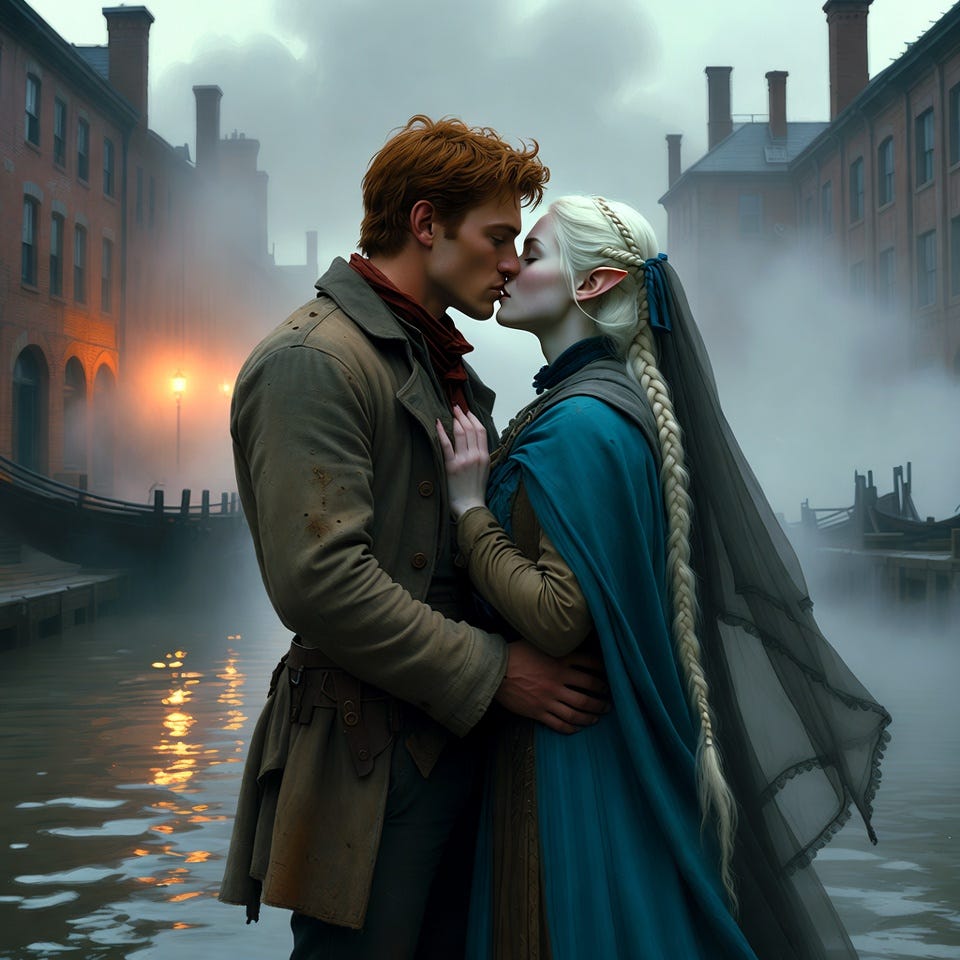
As the merfolk caravan crested the rise above Morgan’s Landing, the whole line stirred like a nest of bees disturbed from sleep. Wagons slowed. Drivers called to one another in a dozen dialects as the first salt breeze rolled up from the bay. Below them, the city glittered—a maze of masts, smoke towers, and brass cranes turning slow against the light.
By the time they reached the outer customs yard, the noise had tripled. Longshoremen swarmed the caravan, shouting for manifests, stamps, and berth numbers. Steam wagons hissed past loaded with crates. The receiving station was a chaos of ramps, chalk-streaked walls, and impatient clerks: the place where land met tide and paperwork.
Joe Tharnen, Junior, swung down first, sleeves rolled, already talking with the merfolk caravan leader—a scar-lined matron with silver gills. Together they headed toward the longshoremen’s foreman to argue unloading schedules and storage fees.
His sister, Mercedes, drifted off in the opposite direction, curiosity winning over caution. She promised she’d reconnoiter the market quarter and meet them later. His father, Joseph Tharnen—the Old Ghost, in the elves’ private lexicon—nodded once and stayed near the wagons, scanning the yard with the careful eye of a man who’d survived too many ambushes to ever relax.
The air buzzed with orders, laughter, and the clang of hoists. It was the kind of noise that promised either profit or trouble, depending on who blinked first.
Uscoshi Stormpetal and Kitamar Dawnstrider stepped down last, veils drawn, each wearing a thin weave of gray silk that softened light and hid everything but the gleam of their eyes. Even veiled, heads turned; beauty that intense could never be disguised entirely.
“Leave word with the merfolk,” Uscoshi said. “If we don’t return before you leave to our lodgings, they should know where to send us.”
Kitamar adjusted her gloves, voice dry. “Before I leave to our lodgings? Where are we going?”
“We are not going anywhere.” Uscoshi’s gaze flicked toward Mac, who was checking the straps on his pack. “I’m taking a better bodyguard. One who doesn’t frighten the paperwork.”
“I do not frighten paper.”
“No,” Uscoshi said, just a hint of mischief behind the veil, “but your presence would distract the staff. Badly.”
Kitamar’s brows rose, amused despite herself. “Distract?”
“Half the clerks in the quarter would forget their own names as they stared at you. The other half would soil themselves. As you know all too well.”
Kitamar’s eyes narrowed behind her veil. “You intend to walk halfway across the ward with him?”
“I’ll bring him back in one piece.”
“Try not to break him. I would not care to explain that to the Old Ghost.”
Uscoshi gathered her cloak. “If he breaks, I’ll glue him back together.”
Mac, who had been tightening the strap of his pack, froze mid-gesture as both elves turned toward him.
“Walk with me?” Uscoshi asked, light as if the thought had just occurred. “I may need a strong arm.”
Kitamar folded her arms. “You have two of your own.”
“And one of them deserves a holiday.” Uscoshi adjusted her cloak. “Try not to brood while I’m gone.”
She turned to Mac, voice lighter. “Come along before my sister makes me leave a deposit.”
He blinked between them. “Should I be worried?”
“Only if you’re terribly dull,” Uscoshi replied, already stepping into the stream of foot traffic flowing toward the river road.
Morgan’s Landing at noon was a living engine—fog curling beneath iron bridges, bells chiming from ferry towers, and the smell of tar, roasting coffee, and citrus rolling through the streets. Steam carts hissed along the cobblestones, hauling crates marked in strange symbols. Mac kept to Uscoshi’s right, scanning the crush of bodies.
He wasn’t new to cities. Delano, with the University, had been larger, cleaner, more predictable—but the riverfront felt alive in a way Delano never did. There, life ticked by in lectures and schedules. Here, it pulsed, with a new adventure around every corner.
Uscoshi moved through it as if it parted for her. Even veiled, people stepped aside without knowing why. He tried to match her stride, which only made him look like a nervous guard at parade rest. When a crate slipped from a dray and hit the cobbles, he shifted instinctively, weight forward.
“Are you protecting me,” she asked from behind the thin silk, “or auditioning to wrestle produce?”
He straightened. “Barrels, I think. You can see them coming.”
Her laugh carried even through the veil. It was soft and far too melodious for his equilibrium. “Then we’ll count on your reflexes if the fruit stampedes.”
They turned down a narrower lane where ink and salt mingled in the air. A weathered sign read A. Arcana & Daughters — Maps · Charters · Navigational Supplies. Inside, the shop smelled of old vellum and copperplate ink.
Clerks looked up from behind their counters and froze. One rose so abruptly he nearly toppled his stool as he hurried towards her. “Stormpetal,” he managed, bowing low. “Ma’am, we — we weren’t expecting —”
“Few people do.” Uscoshi rested one gloved hand on the counter. “I’ll need three courier slips prepared under the usual seals—Durleigh, Cavendyr, and the Freeholds. I’ll send word where the replies are to be delivered once I’ve secured lodgings.”
“Yes, ma’am.” His pen scratched furiously.
“And,” she continued, “I’ll be expecting a summary brief of the usual updates by end of business today. Do you have any questions?”
He swallowed. “No, ma’am.”
“Good.” She paused. “Be sure Ayela knows this has the highest priority.”
“I will, ma’am.” The clerk blurted, “Is the Dawnstrider with you?”
“No.”
Relief flooded his face. “Understood. Thank you, ma’am.”
She nodded. “I understand her presence tends to distract the staff.”
He flushed crimson. “Quite so.”
Uscoshi signed the slips with a practiced flourish, slid a small pouch of coin across the counter, and lowered her voice just enough that Mac had to lean in. “Ensure the ledgers show these as Guild transfers to our humanitarian fund. Understood?”
“Of course, Stormpetal. We’ll make sure the unfortunates are taken care of.”
Uscoshi inclined her head, the faintest shadow of approval crossing her veil. “Excellent. Efficiency deserves reward.”
She turned to Mac, the business mask falling back into serenity once more. “Paperwork complete. Now we wait—and walking helps me think.”
They stepped out into the washed light. Behind them, the clerk locked the door and exhaled like a man who’d survived an audience with an executioner.
Mac glanced sideways. “He seems nervous.”
“They always are,” she said softly. “They think talking to me means they’ll have to balance their souls as well as their books.”
He didn’t ask what that meant. He just followed her into the glittering noise where the city met the sea.
The upper ward narrowed toward the riverfront, each street bending into another like the ribs of a fan. The fog carried the smell of coal and oranges; merchants called prices over the wheeze of steam carts and the slap of ropes against metal bollards. Music leaked from somewhere—a fiddle keeping time with the clatter of hooves.
Uscoshi moved as if she had drawn the map herself. Even veiled, people made room without realizing it. Mac trailed half a step behind, watching her cloak brush the air as if it commanded gravity. He tried to look casual and failed; too much rancher in his stride, too much wonder in his eyes.
Two dockhands near a spice stand broke off their argument to stare after her. “Careful o’ that one, boy,” one muttered. “’The rage of an elf’s unquenchable.’”
His friend snorted. “Aye, but I’d risk the burn for that ‘un.”
Uscoshi didn’t slow. “They aren’t wrong,” she murmured, just loud enough for Mac to hear.
He risked a glance at her veil. “Are you angry?”
“Perpetually,” she said, smiling at him. “But not at you.”
The line left him half-smiling, half-unnerved. Her smile was dazzling. It made him forget everything else. When the crowd thickened, she reached back without thinking and caught his wrist to steer him clear of a barrel cart. The contact was brief—glove to sleeve—but it hit him like a live wire.
Realization flickered across her face, gone almost before it formed. She released him quickly, voice smooth again, perfectly controlled. “Do keep up, Mac. I’d hate to tell your father you were lost to commerce.”
He grinned despite himself. “Barrels, remember? I can see them coming.”
They turned a corner and the world changed smell. Sweetness replaced salt as Mac inhaled the scent of sugar glazing nuts over a copper pan. Uscoshi stopped. The vendor’s ladle moved in slow circles, honey hissing as it hit the heat.
“I haven’t tasted those since Durleigh,” she sighed quietly. “A year ago, I suppose.”
Before she could step away, Mac was already fishing a coin from his coat. “Two cones,” he said.
She made a small sound of protest—habit, not pride—but he’d paid before she could refuse. He handed one to her awkwardly, the paper cone trembling slightly between his fingers.
She accepted it with both hands. “Thank you. You’ve no idea how rare it is for anyone to feed me. Or do anything for me without expecting something in return.”
He reddened. “Happy to, uh… help.”
She laughed softly, peeled off one glove, and plucked out an almond. Honey caught the light on her fingertips before she ate it. A faint sigh followed: contentment edged with memory. “Perfect. Exactly as I remember.”
Mac watched her, suddenly certain he’d done something right without knowing how. When she offered him one in return, he took it carefully, their fingers almost brushing through the veil of steam.
They followed the canal until the noise thinned to gulls and water. A line of stone benches faced the loading slips, where children ran along the railing and a priest scolded them half-heartedly. The tide licked the pilings below.
Uscoshi sat first, adjusting her veil so the breeze could touch her face. “You can stop scanning for assassins,” she said. “Sitting beside me counts as protection.”
He settled next to her, the stone cool through his coat. “You did tell the Dawnstrider you needed a bodyguard.”
“True, I did,” she allowed. “Still, I prefer quiet to vigilance.”
For a while they simply watched the docks breathe. Ropes creaked as boats nudged each other, while gulls turned slow spirals overhead. It was the first calm either had found since leaving the caravan.
“Delano never sounded like this,” he said at last.
“No.” Her eyes softened behind the veil. “Delano listens to itself. Morgan’s Landing listens to everyone else.”
He nodded, letting the words sink in. The breeze carried the scent of almonds between them, warm and clean. Somewhere behind the silk, she smiled.
The wind off the canal lifted her veil for a heartbeat before it settled again. Sunlight broke through the fog, scattering across the water like shards of glass.
Uscoshi watched the light move, her voice quiet enough that he almost missed it. “I used to think there was a song beneath all this,” she said. “A note the world hums when it’s at peace.”
Mac tilted his head. “You mean… music?”
“Something older than music. Stronger.” She paused, tracing a pattern on the bench with one gloved finger. “I heard it long ago. It was the song I was born hearing. I thought it lost.”
Her gaze drifted to him, the faintest curve of a smile behind the silk. “But lately,” she said, softer now, “I think I can hear it again.”
He didn’t know what to say. The words felt too large for speech, too fragile for sound. He only nodded, the meaning landing somewhere deep where logic couldn’t reach.
She let the silence linger, as if that were answer enough.
They rose and followed the canal toward the artisan quarter, where the air shifted from salt to smoke and flowers. A herbalist’s cart stood by the curb, its trays lined with sprigs of mint, thyme, and feverroot.
Uscoshi paused, fingertips brushing a bunch of bright green leaves. She plucked one sprig and, without thinking, tucked it into his coat pocket. “For luck,” she said.
He blinked, half laughing. “I’ll try to deserve it.”
They moved on. At the next stall a woman sold ribbons by the spool—dyed silk, linen, even the finest cotton. Mac hesitated in front of the table, fingers brushing a strip of blue so deep it caught the light like water. It reminded him of her eyes.
He bought it before he could change his mind. When she noticed, her voice softened.
“For me?”
He fumbled. “It, uh—matched your eyes.”
A smile touched her lips beneath the veil. “Then I’ll take good care of it,” she said, extending her hand.
He placed the ribbon in her palm, the silk brushing his fingers as she folded it neatly and slipped it into her sleeve. “Thank you,” she added.
He nodded, tucking the mint sprig back into his pocket and feeling suddenly absurdly wealthy.
They reached a narrow bridge of barges lashed together, its planks damp and slick underfoot. The canal below reflected the gray sky, the water trembling with each passing wake.
“Careful,” she murmured, taking his arm for balance.
Her hand settled lightly at his elbow, the contact deliberate this time. The noise of the city fell away: the vendors, the laughter of the crowd, even the bells—and for a moment there was only the rhythm of their steps and the low, patient sound of the tide.
Mac slowed, unwilling to break the moment. He could feel her pulse through the thin glove, steady and sure.
On the far side of the bridge, a busker strummed a harp. The melody was old and wistful, about a sailor lost at sea and the woman who kept the lantern lit. The tune followed them like a blessing as they stepped back onto solid ground.
Uscoshi released his arm but didn’t move away immediately. Her voice was soft, almost thoughtful.
“I love that song. Some fires don’t burn to destroy,” she said. “They burn to guide the lost home.”
He wasn’t sure if she meant him or herself, but he hoped it was both.
They had wandered past the last of the merchant stalls into a quieter stretch of the canal. Here the fog thickened and the lanterns burned dimly through it. The sound of the harbor had softened to a distant murmur.
Mac slowed his steps. She felt the change before she saw it, the way his breathing shortened, the way his hands brushed the railing once, twice, before he spoke.
“I don’t really know how to do this,” he said.
Uscoshi tilted her head. “Do what?”
“This.” He gestured vaguely—her, the street, the silence between them. “Talking. Walking. Not making a fool of myself.”
She waited, patient.
He gave a small, helpless laugh. “I’ve never had… anyone. Not like this. Not someone who—” He stopped, searching for words, then let them fall out raw.
“Someone pretty like you could have her pick of anyone she fancied. I’ve never mattered like that to someone. I don’t want to mess it up.”
For a moment, the fog was the only thing moving. Then Uscoshi turned toward him, veil shifting with her breath.
“You’re right,” she said quietly. “I could have my pick of any man. I choose you. You matter to me.”
He blinked. “Why?”
“Because you’re you,” she said simply. Then, softer: “And because you listen when I speak. And sometimes, despite what I say.”
Her words hung between them, fragile as glass. She felt her pulse in her throat, echoing against the years she had carried alone.
She drew a slow breath, gathering herself before courage failed. “Do you know what an elven hand-kiss means?”
He shook his head, grateful for a change of topic to hold onto.
“It’s not a courtly habit,” she said. “It’s a promise. The back of the hand, eyes lifted. It means you have my respect—and my permission.”
Mac hesitated, then lifted her gloved hand. His hands were rough, work-hardened, and he moved carefully, afraid she might laugh. She didn’t. She seemed… nervous. The faintest tremor touched her breath, a hesitation he’d never seen before.
He brushed his lips lightly across the silk, then looked up as she had described.
Uscoshi’s breath caught. The gesture was simple, clumsy even, but he did it with reverence, not charm. She felt her composure fray.
“Now,” she said softly, “you’re supposed to let me return it.”
He blinked, startled. “I thought—”
But she had already taken his hand. Slowly, deliberately, she turned it palm-up and pressed her lips against the rough skin, just below the thumb. The kiss was light, almost a question. When she let go, her hand lingered for a heartbeat longer than it should have.
Neither of them spoke. The world felt very small, the air too thin, the moment impossibly fragile.
Then she smiled. It was genuine and bright, utterly disarming.
“See? No one died. You learn quickly, Mac.”
He managed a shaky grin. “You’re a good teacher.”
Her eyes softened. “You have no idea.”
The world didn’t quite start again after that. It lingered, as if waiting to see what they’d do next. The fog had settled low over the canal, softening every edge until even the lanterns looked shy.
Mac opened his mouth, then closed it again. Words felt clumsy, too loud for what sat between them. She was still looking at him, veil half-lifted by the wind, eyes bright and uncertain in a way that made his heart stumble.
He didn’t plan it. He just leaned forward, a single, helpless motion—and kissed her.
It was a small, awkward peck, barely more than a brush at the corner of her mouth, but it carried everything he couldn’t say. The instant it happened, he froze, horror flooding in.
“I—sorry, I shouldn’t— I didn’t mean—”
Uscoshi blinked, startled, and for a heartbeat he saw her defenses rise. The centuries of training, the walls she had built to guard her heart. Then they melted away just as quickly. A breathless laugh escaped her, soft and astonished.
Before he could retreat fully into his own mortification, she caught his coat sleeve and tugged him gently back toward her.
“You have nothing to be sorry for,” she whispered.
And then she kissed him.
It was slow and certain. Not a test but an answer.
The world narrowed to breath and warmth, to the faint taste of honey and almonds, to the impossible gentleness of her hands against his shoulders. Her veil slipped aside, caught in the wind, forgotten. The city sounds fell away until there was only the lap of the river and the low hum of lantern light.
She drew back first, though not far. Just enough to rest her forehead against his. Both were smiling, both a little dazed.
“You taste like almonds,” he murmured.
“So do you,” she replied, laughter threading through the words.
For a moment neither moved. Then she exhaled, the sound more sigh than speech. She leaned in against his chest.
“Mac, I don’t want to mess this up either. I’m so scared I will. We’ll be patient with each other,” she said. “That’s how the song goes, after all.”
He nodded, too full to speak.
Inside, she found it impossible to keep from singing. Mine. He’s mine. He’s still mine.
Her smile returned, wry and tender. “I suppose I should have seen that coming,” she murmured.
For a while they simply breathed the same air, the city holding its noise in deference. Then the fog shifted; sound returned in small pieces. The cry of a gull. The low thrum of the river.
Uscoshi drew back just far enough to settle her veil again. Her movements were careful, almost ceremonial, as if the simple act of covering her face re-stitched the world.
“I should probably let you breathe,” she said, voice soft with humor.
“I’m perfectly fine as we are,” he murmured.
She laughed quietly, the sound more sigh than song. “Good. I’d hate to have to explain to your father that you fainted on the docks.”
Before he could answer, a sharp click of boots echoed through the fog. A courier in a gray coat stepped from the shadows, hat pressed to his chest. “Are you the Stormpetal?”
Uscoshi’s spine straightened; the old calm slid neatly back into place. “I’m she.”
The man offered a sealed envelope stamped with wax. “From the Arcanas, ma’am. Said it couldn’t wait.”
She took the letter with a nod, breaking the seal as the courier vanished as quickly as he’d appeared. Her eyes moved across the short message; when she looked up again, the lightness of a moment ago had dimmed.
“Some initial reports about Trade Authority activity,” she said. “We need to get back to the caravan and update your father.”
Mac heard the quiet shift in her tone. The return of command in her voice told him the moment had passed, for now. He nodded. “Then we’d better get started.”
She folded the note, slipping it into her sleeve. “Yes, we had better—” she stopped, then smiled.
“Yes,” she repeated. This time the word fit like her glove. “We had.”
As they turned toward the market road, she reached into her pocket. The blue ribbon he’d bought earlier still lay there, folded neatly. She unwound a strand and wove it into her braid with quick, practiced fingers.
Mac caught the motion, saw the flash of color against gray silk, and smiled without speaking. The meaning didn’t need words.
He reached for her hand, and this time she didn’t pull away. Their fingers intertwined easily, like two halves of something long divided finding their shape again. The warmth between them was steady, unhurried, alive.
As the lights of the Landing glowed through the gathering fog, they walked on together, the ribbon trailing a soft thread of blue behind them, bright as hope, quiet as the song she’d once thought lost.
They might say the rage of an elf was unquenchable, she thought. But even a veil of rage could be lifted by love.
I love the gentleness of your words. Thanks for sharing :)
I appreciate you sharing your reflections. I’ve been exploring similar themes in a very different genre. It’s interesting how these questions show up across styles.